Tampa, Florida
The site they started themselves
A premium cigar brand began building its own storefront and stopped partway, once the regulatory detail and the hours both turned out to be larger than they looked.
The situation
Elevado is a cigar-first, craft-first brand — tobacco heritage, construction and aging — that introduces a carefully controlled hemp-derived experience in an adult context. Two blends across two strengths, sold in two directions: to connoisseurs directly, and to licensed retailers, tobacconists and distributors who want paperwork in front of them before they will stock anything.
They started the site themselves, in a website builder. That is a reasonable first move and we would rarely argue with it — a builder puts a brand online cheaply, and for a good number of businesses that is where it should stop.
It did not stop there, for two reasons that arrived in that order. First the technical requirements of selling a regulated product turned out not to be things a builder has answers for. Then the hours became the real problem — and that is the one that ends most self-built sites.
Built for Elevado Cigars.
What was actually wrong
- It looked like one job and it was several
- A builder handles layout. It does not handle an age gate that holds up, shipping rules that differ by state, a repository of certificates of analysis a buyer can actually find, or a route for licensed retailers to request stock. Each of those is its own piece of work, and none of them look like work until you are inside them.
- The time, not the tool
- The honest failure mode of a self-built site is almost never that the owner could not do it. It is that the site has to compete with running the business, and the business wins — correctly. Progress then stops halfway, which is the most expensive place for it to stop, because the half that exists still has to be unpicked.
- Two audiences, one page trying to serve both
- A distributor evaluating stock and a customer buying one cigar want different things in a different order. Asking a single page to do both means it does neither well.
- A product matrix reduced to a list
- Two blends across two strengths is a grid with a logic to it. Flattened into a product feed, the logic disappears and a customer cannot tell what they are choosing between.
What we built
- Took over a part-built site
- Starting from what existed rather than from nothing, which means deciding what to keep, what to rebuild, and what was only ever a workaround for something the builder could not do.
- A landing page built for atmosphere
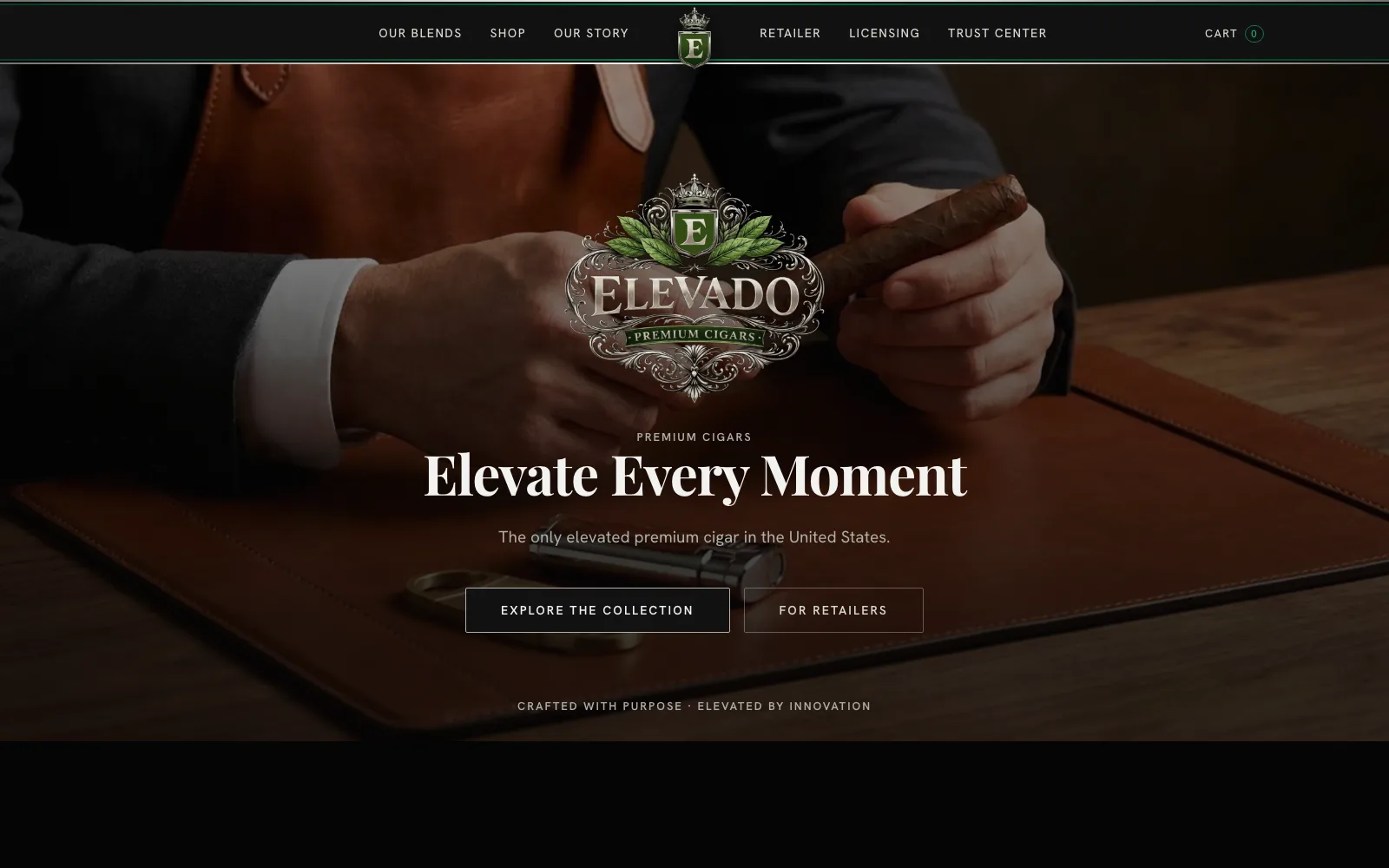
- Cinematic hero, layered mahogany and leather texture, slow drifting smoke, rim lighting. High-fidelity imagery, optimised so that fidelity does not cost the load.
- A serious age gate
- Full-screen, unambiguous, and treated as a legal boundary rather than a modal to dismiss.
- The blend matrix as the product showcase
- Two blends, two strengths, presented as the structure it is, so the choice explains itself.
- A retailer and lab-documentation layer
- A wholesale route for licensed partners to request inventory, and a transparent home for COAs and safety data — the documents that decide whether a stockist takes the brand seriously.
- WooCommerce catalogue and checkout
- Product cards as presentation frames, and a checkout that stays streamlined while respecting where the product can and cannot ship.
This engagement has no measured figures we can publish, so none are shown. We are happy to provide references on a call.